At 32", resolution stops being a “nice-to-have” and starts being a comfort/clarity thing: 1440p looks noticeably less crisp at typical desk distances, while 4K brings text/UI sharpness and finer game detail (and lets you use sensible scaling for productivity). The other big decision is panel type: OLED/QD‑OLED is the king of contrast and motion clarity, while Mini‑LED/VA can be brighter for sunlit rooms but has more “LCD trade-offs.”
Desk-wise, 32" is physically big: you’ll feel it most in desk depth (viewing distance) and stand footprint (some of these have wide “V” legs). If your desk is < ~25" deep, a monitor arm becomes the difference between “perfect” and “overwhelming.”
My best picks (32" gaming)
Best overall 32" gaming monitor (most people should buy)
MSI 32" MPG 321URX QD-OLED (from $829.99 - 14 sellers)
- Why it wins at 32": 4K + QD‑OLED gives you the sharpness 32" needs and OLED’s perfect blacks / instant pixel response for clean motion.
- Great for: single-monitor “do everything” (AAA + competitive + general desktop).
- Worth noting: OLED maintenance/protection features can be a little intrusive for some users; brightness in very bright rooms can be the limiting factor.
Best 32" OLED value alternative (especially if you like curved)
Alienware 31.6" AW3225QF (QD-OLED) (from $799.99 - 4 sellers)
- Why you’d pick it: still 4K/240Hz QD‑OLED, usually priced aggressively, and the curve can feel more natural at 32" if you sit close.
- Trade-off: curved isn’t everyone’s favorite for productivity/straight lines; also fewer “utility” features than some rivals.
Best for bright rooms / “I want HDR pop” without OLED concerns
⚡ DEAL ALERT! Samsung 32" Odyssey Neo G8 Curved (from $749.99 - 4 sellers)
- Why it’s the LCD pick: very strong “punch” in highlights (Mini‑LED-style HDR experience tends to feel brighter than OLED in daylight rooms).
- Trade-off: common LCD quirks here—reports of scanlines/flicker at high refresh on some setups. If you’re sensitive to that, OLED is safer.
Why 4K matters more at 32"
- Pixel density: 32" 1440p is ~92 PPI (softer edges, less crisp text). 32" 4K is ~138 PPI (noticeably sharper).
- Better scaling flexibility: You can run 4K at 125–150% scaling for comfort while keeping UI crisp.
- Games look “cleaner” at normal viewing distances: less shimmering/aliasing pressure than 1440p at the same size.
Panel type quick guide (the real “feel” difference)
- QD‑OLED/OLED: best contrast, best motion clarity, incredible HDR blacks. Main watch-outs: brightness in sunlit rooms, and OLED care features (pixel refresh, dimming behaviors).
- Mini‑LED / high-end VA LCD: brighter overall and strong HDR highlights; watch-outs: blooming, black smear/VA response limits, and model-specific scanline/flicker issues.
- IPS (non-miniLED): great viewing angles and “clean” image; black levels/HDR impact typically weaker than OLED/Mini‑LED.
Desk space considerations (don’t skip this)
- Desk depth: For 32", a sweet spot is often ~28–32" viewing distance. Shallow desks can push you too close, making eye/head movement feel tiring.
- Stand footprint: Several 32" gaming stands are wide and desk-hoggy (some reviews even call this out on certain models). If you need keyboard/mouse room, prioritize VESA mount compatibility and plan for an arm.
- Flat vs curved: Curved can feel more comfortable at 32" if you sit close; flat is usually better if you do lots of design/docs/spreadsheets.
Side-by-side comparison
MSI 32" MPG 321URX QD-OLED 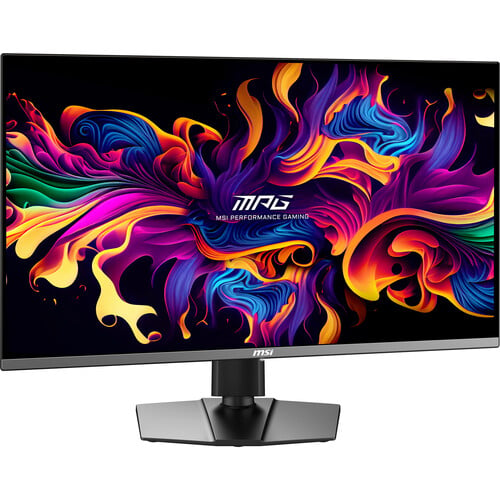 |
Alienware 31.6" AW3225QF 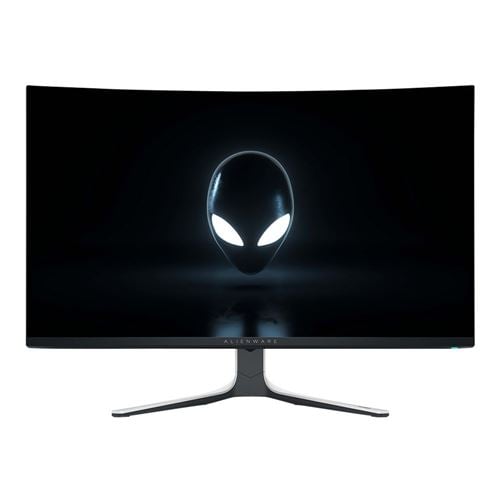 |
Samsung 32" Odyssey Neo G8 Curved 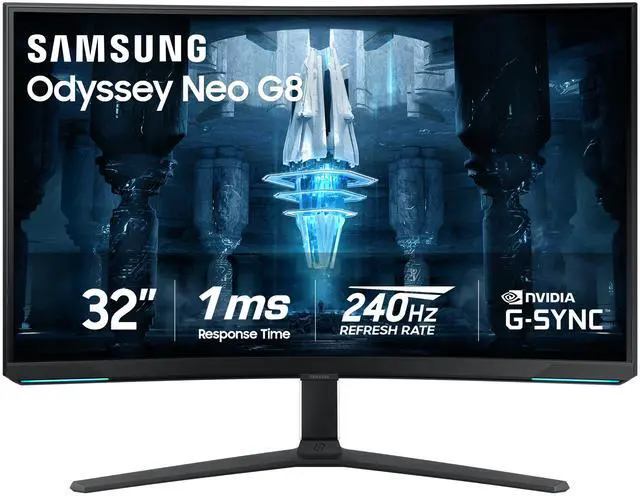 |
|
|---|---|---|---|
| Price (from results) | $829.99 | $799.99 | $749.99 |
| Sifty Score | 96 | 92 | 86 |
| Resolution / refresh | 4K, 240 Hz | 4K, 240 Hz | 4K, 240 Hz |
| Panel type | QD‑OLED | QD‑OLED | VA (Neo G8 class / HDR-focused LCD) |
| Why 4K at 32" here | Very sharp text + max detail | Same 4K sharpness + immersive curve | 4K clarity plus bright-room usability |
| Motion clarity | Excellent (OLED response) | Excellent (OLED response) | Very good, but LCD artifacts can appear |
| HDR “feel” | Deep blacks; great contrast | Deep blacks; great contrast | Bright highlights; can feel punchier in daylight |
| Desk/fit notes | Typical 32" footprint; arm-friendly | Curved can reduce “edge distance” feel | Curved + often chunky stand; plan desk space |
| Gotchas | OLED protection features; not the brightest in sunlit rooms | Curved preference; some setup/fragility complaints | Scanlines/flicker reports; QC variability |
| Best for | Best overall “one monitor” choice | Best value OLED pick if you like curve | Bright rooms / highlight-driven HDR without OLED care |
If you want the smartest buy with the best 32" experience, I’d pick MSI 32" MPG 321URX QD-OLED (from $829.99 - 14 sellers). Choose Alienware AW3225QF (from $799.99 - 4 sellers) if you want similar OLED performance with a curve and strong value; choose ⚡ DEAL ALERT! Samsung Neo G8 (from $749.99 - 4 sellers) if your room is bright and you care more about “HDR punch” than OLED blacks.
To lock this to one perfect pick:
Are you primarily on PC with a strong GPU, or PS5/Xbox, or mixed use?
PC (RTX 4070+ / RX 7800 XT+)) Console-first) Mixed PC + console
How bright is your room where the monitor sits?
Do you prefer a flat screen or are you open to curved at 32"?
See 121 results